DSIP research: a name, then a redesign | NewGen Peptides
DSIP (Delta Sleep-Inducing Peptide) began with a sleep claim. The newer fusion experiment is interesting precisely because it changed the peptide.
DSIP origins and the critical review
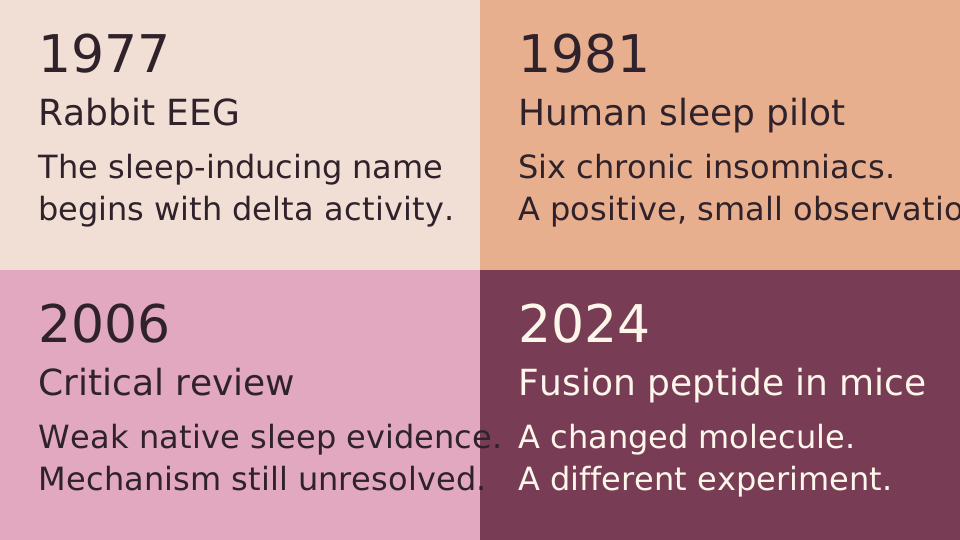
DSIP was isolated in 1977 from the cerebral venous blood of rabbits during electrically induced sleep. Infusing it into the brain enhanced slow-wave delta EEG activity. A nine-amino-acid peptide, Trp-Ala-Gly-Gly-Asp-Ala-Ser-Gly-Glu, acquired a name that described that finding: Delta Sleep-Inducing Peptide.
The name lent DSIP more certainty than I could justify after the review. The 2006 review of native DSIP and its analogs describes sleep evidence that remained weak and an unresolved mechanism, with no conclusively identified receptor, gene or precursor. The review also points out that structural analogs, rather than native DSIP, supplied the clearest sleep-promoting effects.
That is the peculiar inheritance of DSIP research. The name sounds settled; the molecular explanation and the reproducibility are not. A peptide reported in biological fluids is not automatically a well-understood regulator, nor does endogenous mean safe.
The human sleep pilot
The 1981 sleep study in six middle-aged chronic insomniacs reported longer sleep, fewer interruptions, slightly more REM sleep and no daytime sedation after intravenous synthetic DSIP. The sleep-promoting effect appeared in the second hour; the first showed slight arousal.
I take that finding seriously without treating it as a dependable sleep aid. It is an old, small human pilot, and the later review’s criticism of the overall record still has to be answered. A positive night in a small experiment and a repeatable benefit in a defined patient population are different achievements.
The timing is also a useful antidote to the idea of an immediate knockout. It describes those study subjects under those conditions. It supplies no schedule for a person trying to improve sleep.
DSIP fusion-peptide experiment in mice
The 2024 DSIP-CBBBP fusion-peptide experiment used male Kun-Ming mice with insomnia induced by PCPA, a chemical that inhibits serotonin synthesis. The fusion peptide was engineered to cross the blood-brain barrier, the selective boundary controlling entry from blood into the brain.
Average daily wakefulness fell from about 720 minutes to about 500 minutes, a reduction of about 31%. The study also reported restored melatonin, serotonin and dopamine levels, improved anxiety- and depression-related behaviours, and increased hippocampal neuron density. The engineered peptide outperformed unmodified DSIP.
This is the newer result I’m most willing to call an interesting redesign. Its boundaries are part of the interest: a modified peptide, an induced insomnia model and mice. It does not show that native DSIP works reliably for human insomnia, and it does not overturn the older review by changing the date on the same claim.
ACTH and mouse lifespan findings
The 1989 experiment measuring ACTH-like immunoreactivity in men found a reduction lasting at least three hours, while cortisol followed its normal decline without a change attributable to DSIP. That is a human hormonal finding. A benefit for sleep or stress does not follow automatically from it.
The DSIP-containing preparation study in female SHR mice is another distinct branch. It reported a 24.1% increase in maximum lifespan, a 17.1% extension in survival of the last 10% of the cohort, a 2.6-fold reduction in spontaneous tumour incidence and a 22.6% reduction in bone-marrow chromosome aberrations. Those results concern that preparation and that mouse strain; the single-lineage longevity evidence needs replication.
For me, the danger is accumulation: sleep, hormones and lifespan begin to sound like confirmations of one grand effect. They were different experiments with different questions. Listing them together should not manufacture a conclusion none measured.
DSIP anecdotes and safety
Anecdotal accounts describe easier wind-down, deeper-feeling sleep, vivid dreams and clear mornings. There are also accounts of no effect, next-day grogginess, headaches and inconveniently delayed sleepiness. These accounts remain anecdotal; a repeatedly quoted estimate of how many people respond still lacks a measured response rate.
DSIP has no approved drug product. Emideltide is its International Nonproprietary Name; the approval status remains unchanged. U.S. clinicians can assess individual requests for a compounded prescription, and research-labelled material remains separately available; neither changes the approval status.
Long-term human safety and a validated human pharmacokinetic profile are missing. Combinations with sedatives or alcohol are untested, and safety in pregnancy, breastfeeding or relevant pre-existing conditions is unknown. Persistent sleep problems can have treatable causes that a research-peptide story does not diagnose.
I’d rather leave DSIP with an unfinished question than give its confident name the last word. The generation that changes the human evidence has yet to appear in this reading list.